Scaffolded Instruction: 7 Teaching Strategies That Build Foundational Skills
Effective teaching begins with meeting students where they are—and helping them move forward.
Students do not all develop foundational skills at the same pace. Some need additional practice; others need clearer explanations, smaller instructional steps, or more opportunities to demonstrate understanding. Whether you teach special education, lead a general education classroom, or homeschool, these supports can make challenging skills more accessible.
At Resource Teacher’s Guide (RTG), our resources are designed around explicit instruction, intentional scaffolding, and evidence-informed teaching practices. Our experience comes from special education classrooms and instructional coaching, but the underlying strategies can support learners in many settings.
What is scaffolded instruction?
Scaffolded instruction provides temporary, purposeful support while students learn a new skill. A teacher might model a task, offer prompts or visuals, guide practice, and then gradually remove support as the student becomes more independent.
Scaffolding is not the same as permanently lowering expectations. Its purpose is to help students engage with challenging learning while building the skills they need to succeed.
For example, a student learning to decode words may first practice hearing and blending sounds, then read simple words with guidance, and eventually apply the skill independently in connected text. A developing writer may receive sentence models before constructing sentences and paragraphs more independently.
Why explicit instruction matters
Explicit instruction makes the learning process visible. The teacher explains the target skill, demonstrates it, guides practice, checks understanding, provides feedback, and creates opportunities for independent application.
For a student who struggles to blend sounds, this might mean hearing the teacher demonstrate how to combine individual phonemes, practicing together, and then trying unfamiliar words with immediate feedback.
Research-based practice guides from the Institute of Education Sciences and the Council for Exceptional Children’s High-Leverage Practices describe instructional approaches that include clear modeling, scaffolded supports, and feedback.
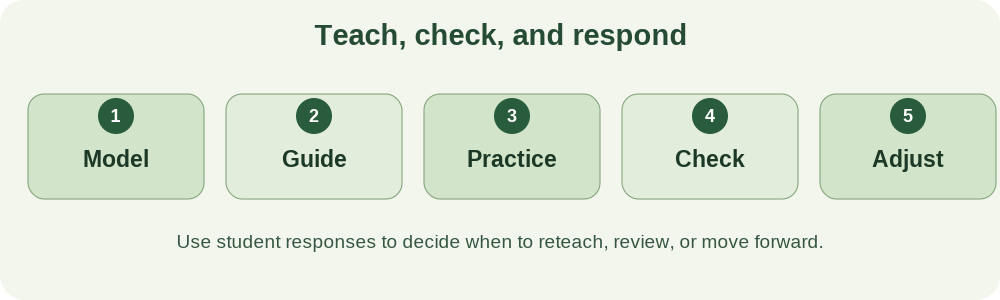
An adaptable instructional cycle: model the skill, guide practice, provide opportunities to apply it, check performance, and adjust instruction.
Seven teaching principles behind RTG resources
1. Explicit instruction: make the skill clear
Explain and demonstrate exactly what students are learning. A teacher teaching sound blending can model how to combine sounds into a word before asking students to try.
2. Scaffolded learning: break down complex tasks
Identify manageable steps and offer support when needed. For writing, students might first practice complete sentences, then organize related ideas, and later develop a paragraph.
3. Mastery-based progression: respond to readiness
Use student performance to decide whether to provide additional instruction, introduce a more complex skill, or offer new applications. Mastery checks should guide instruction—not prevent students from engaging in meaningful grade-level learning.
4. Cumulative review: revisit earlier learning
New lessons should create opportunities to practice previously taught skills. When introducing beginning blends, for example, students can continue reviewing letter sounds and simpler decoding patterns.
5. Gradual release: build independence
Move flexibly from I do (teacher modeling), to we do (guided practice), to you do (independent application). If students need more support, return to modeling and guided practice.
6. Purposeful multisensory activities: connect seeing, hearing, saying, and doing
Use activities that serve the learning goal. Students learning spelling patterns might see the letters, say the sounds, and write the words with feedback. This is different from the unsupported idea that every child has a fixed visual, auditory, or kinesthetic learning style.
7. Data-driven instruction: check and adjust
Use short skill checks, student responses, and progress monitoring to decide what to teach next. The purpose of collecting data is to improve instruction, not simply to create paperwork.
What does this look like in a real lesson?
Imagine a student who knows individual letter sounds but has difficulty reading consonant-vowel-consonant (CVC) words.
The teacher identifies the specific difficulty, models how to blend the sounds, and provides guided practice. The student reviews familiar sounds alongside new words, receives immediate feedback, and gradually practices more independently. A short skill check shows whether to continue, reteach, or increase complexity.
Rather than relying on additional worksheets alone, instruction connects assessment, modeling, practice, and feedback.
Strategies for special education, general education, and homeschool
Special education: targeted intervention
Resource teachers can use systematic instruction and progress monitoring to target foundational skill gaps while continuing to support access to grade-level learning. Clear lesson routines can also help manage limited instructional time.
General education: flexible small-group support
Classroom teachers can use explicit modeling and scaffolded practice in whole-class lessons or targeted small groups. A student needing extra decoding instruction can receive focused practice without being excluded from broader literacy activities.
Homeschool: structure with individualized pacing
Homeschool families can benefit from clear teacher directions, guided examples, and skill checks. A parent can spend longer on a challenging skill, revisit previous learning, or move forward as a child demonstrates understanding.
Effective instruction is not defined by where learning happens. The same principles can be adapted to different settings and learners.
Scaffolding does not mean lowering expectations
Students who need foundational instruction can still participate in rich, grade-level learning experiences. A child working on decoding can also discuss complex stories read aloud. A child learning sentence construction can still develop sophisticated ideas.
The aim is to build independence and access—not to make support permanent.
Research-informed and practical
RTG’s approach draws on established instructional practices while recognizing the realities of busy classrooms and family learning environments. We aim to provide resources with clear teaching guidance, systematic skill development, meaningful practice, and opportunities to monitor progress.
Research supporting a teaching practice is not the same as independent evidence that a particular RTG product has been experimentally validated. We use “research-informed” to describe the instructional principles that shape our materials.
Our resources are created by experienced special education teachers and coaches, with the goal of making purposeful instruction easier to implement.
Helping every learner move forward
Explicit instruction, scaffolding, cumulative review, guided practice, purposeful multisensory activities, mastery checks, and progress monitoring work best as connected practices. Together, they help teachers and families identify what learners need and respond with appropriate instruction.
Created by special education teachers. Designed to support every learner.
Explore our reading intervention resources, learn how to choose a reading intervention, or read why we created RTG.
Research and further reading
- Institute of Education Sciences, What Works Clearinghouse: Practice Guides. Includes Foundational Skills to Support Students in Kindergarten Through 3rd Grade (2016) and guidance on intervention and progress monitoring.
- Council for Exceptional Children and CEEDAR Center: High-Leverage Practices. Professional guidance on explicit instruction, scaffolding, feedback, and assessment.
- Rosenshine, B. (2012). Principles of Instruction: Research-Based Strategies That All Teachers Should Know. American Educator, 36(1), 12–19, 39.
These references support instructional principles, not independent evaluations of RTG products.