How to Choose the Right Reading Intervention for Struggling Readers
Finding the right reading intervention program for your students can be a slow and frustrating journey.
You may finally feel like you have a strong literacy instruction system in your classroom. Most of your students are making progress, and you’re seeing the results of your hard work.
But what about the students who aren’t progressing?
No matter what you try, some students continue to struggle with foundational reading skills. You know they need something different, but figuring out exactly what they need—and finding the right program to provide it—can feel overwhelming.
The good news is that there are specific features you can look for when choosing a reading intervention.
An effective reading intervention should provide:
- Direct, explicit, and systematic instruction.
- Simple, complete lessons that are easy to implement.
- Purposeful assessments and ongoing progress monitoring.
Let’s look at why each of these features matters and how they can help you make better instructional decisions for your struggling readers.
1. Look for Direct and Explicit Reading Instruction
Anyone who works with struggling readers or students with learning disabilities understands how frustrating it can be to see little growth from year to year.
These students often need more than additional reading practice. They need instruction that breaks complex skills into manageable steps, connects new concepts to previously learned skills, and provides multiple opportunities to practice.
That’s where explicit instruction becomes important.
With explicit instruction, the teacher clearly identifies the skill being taught, models the process, guides students through practice, and gradually moves them toward greater independence.
Instead of expecting students to discover patterns on their own, the teacher makes the learning process clear.
A well-designed intervention also follows a systematic sequence. Students practice foundational skills before moving on to more complex ones.
For example, students learning beginning consonant blends should have opportunities to hear the sounds, identify them, practice reading and writing them, and apply them in connected text.
Each lesson builds on what students already know.
What to look for in a reading intervention:
- Clearly defined learning objectives.
- Explicit teacher modeling and guided practice.
- A logical sequence of skills.
- Frequent opportunities for review and repetition.
- Practice applying new skills in reading and writing.
When instruction is carefully sequenced, teachers have a clearer understanding of what students have learned and what needs to come next.
2. Choose a Reading Intervention That’s Simple to Implement
Being a teacher is no easy task.
Between planning lessons, managing behavior, collecting data, communicating with parents, and attending meetings, there isn’t much extra time in the day.
Unfortunately, some reading intervention programs add even more work.
They come with stacks of cards, folders, tiles, manipulatives, and other materials. Before instruction can even begin, teachers may spend hours cutting, laminating, organizing, and learning how to use everything.
And that’s assuming all the materials are available!
We’ve spent time in classrooms coaching new teachers who were given intervention curricula without all the materials needed to implement them.
Sometimes missing materials can be recreated. Other times, teachers don’t even know what’s missing.
Your reading intervention should make instruction easier—not create another job.
Look for programs with clear directions, organized lessons, and materials that are ready to use.
Teacher language and lesson scripts can be especially helpful. They reduce the amount of preparation required and make it easier to deliver instruction consistently.
What Happens When You’re Absent?
Every teacher eventually needs a day off.
Writing substitute plans can be an undertaking, especially when your students require specialized instruction.
Sometimes it’s easier to leave a worksheet than explain an entire reading intervention lesson.
But students benefit from consistent instruction, even when their regular teacher is unavailable.
A program with clearly written instructions and teacher language can help substitutes, paraprofessionals, and instructional aides continue lessons more confidently.
Imagine being able to leave a page number and the necessary materials instead of several pages of explanations!
What to look for:
- Ready-to-use lessons.
- Minimal preparation and organization.
- Clearly written teacher directions.
- Consistent lesson routines.
- Materials that support instruction by teachers and trained support staff.
A simple program doesn’t mean less rigorous instruction. It means teachers can spend more time teaching and less time preparing.
3. Make Sure the Program Includes Purposeful Assessments
Many reading intervention programs include placement assessments to help teachers determine where students should begin.
That’s useful—but placement assessments don’t always tell the whole story.
A Personal Experience With Reading Assessments
As a mom, one of my daughters struggled with reading in elementary school.
I purchased a reading intervention program and gave her the placement assessment.
According to the results, she didn’t need any intervention.
What?!
That didn’t make sense. I could see that she was struggling.
Because I had several years of experience using the program, I decided to examine the skills taught throughout its different levels.
The program had three levels. After reviewing the concepts, I decided to start her at the beginning of Level Two.
And guess what?
She struggled.
There were holes in her foundational reading skills that the placement assessment hadn’t revealed.
We spent that school year working on those skills.
Had I relied only on the placement assessment, I might have missed the very areas where she needed additional instruction.
That experience reinforced something important:
Assessment results are valuable, but teachers also need to examine the specific skills students know and don’t know.
Why Ongoing Progress Monitoring Matters
A strong intervention doesn’t stop assessing students after placement.
It gives teachers opportunities to check student understanding throughout instruction.
Progress monitoring helps answer important questions:
- Has the student mastered the target skill?
- Is the student retaining previously taught skills?
- Does the student need additional practice?
- Is the student ready to move forward?
- Do we need to adjust our instruction?
Without useful data, even a thoughtfully designed intervention can become a guessing game.
You may feel like students are improving, but it’s difficult to know exactly where they’re progressing or where they need additional support.
Data helps teachers make informed instructional decisions rather than simply hoping students are ready for the next skill.
When comparing reading intervention programs, look for clearly defined goals, regular skill checks, and simple ways to record progress.
How RTG Reading Intervention Addresses These Needs
As special education teachers, we understand the challenge of finding resources that provide effective instruction without adding hours of preparation.
That’s why we created RTG Reading Intervention.
Our goal is to provide practical, scaffolded lessons that teachers can implement without complicated materials or extensive preparation.
Our reading intervention resources are designed around three priorities:
Explicit instruction: Lessons follow structured routines and build on previously taught skills, with teacher language to support consistent instruction.
Simple implementation: Print-and-go materials help reduce preparation time and keep the focus on teaching.
Built-in progress monitoring: Defined goals, skill checks, and data collection sheets help teachers track student learning and plan next steps.
Featured Resource: Beginning Blends — Book 4
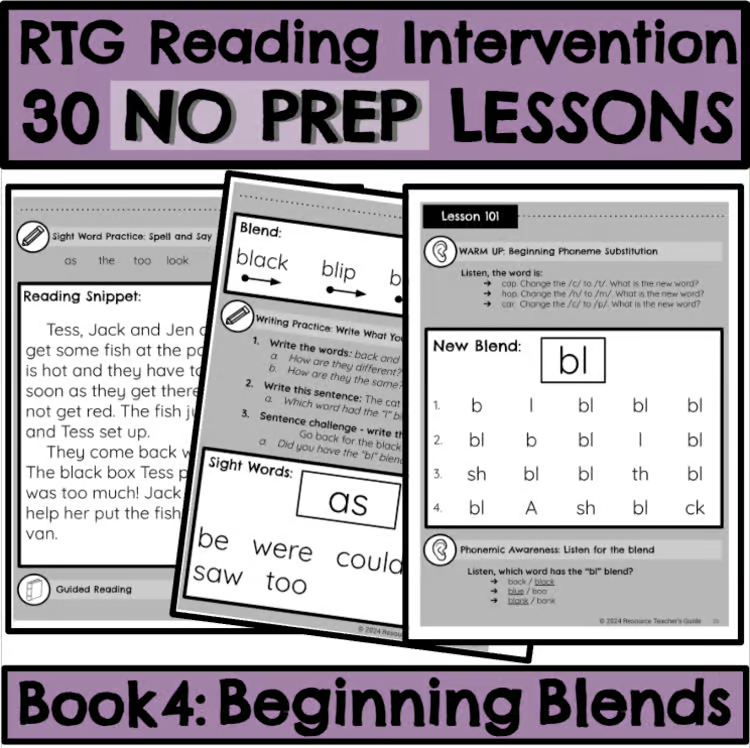
Our RTG Reading Intervention: Beginning Blends resource includes 30 lessons designed for small-group instruction.
The lessons focus on L, R, and S beginning blends, with 10 lessons for each blend group.
Included are:
- A teacher manual and student manual.
- Explicit instruction and written teacher language.
- Opportunities for hearing, reading, and writing practice.
- Application of skills in connected text.
- Goals for each blend section.
- Data collection sheets.
- No-prep, print-and-go lesson materials.
It’s part of our first-grade reading intervention series and was designed with students who need additional foundational reading support in mind.
Explore Beginning Blends — Book 4 on Teachers Pay Teachers
Reading Intervention Checklist: What to Look for Before You Buy
Before investing in a reading intervention program, ask yourself:
- Does the program teach skills explicitly?
- Does instruction follow a clear, systematic sequence?
- Are new skills connected to previously taught skills?
- Are there enough opportunities for guided and independent practice?
- Are the materials organized and easy to prepare?
- Can another trained instructor follow the lessons?
- Are learning goals clearly defined?
- Are assessments included throughout instruction?
- Can I easily collect and review student progress data?
- Does the program fit my students’ instructional needs?
Not every program will be the right fit for every student. This checklist can help you compare your options and identify the features that matter most.
Finding the Reading Intervention That Works for Your Students
Choosing a reading intervention shouldn’t mean guessing which program might work or spending countless hours preparing materials.
Look for instruction that is explicit, systematic, easy to implement, and supported by meaningful assessments.
Most importantly, choose resources that help you understand exactly what your students know, where they are struggling, and what they need to learn next.
Your time is valuable. Your students’ instructional time is valuable, too.
The right tools can help you make the most of both.